


Criminal Law and Technology

Table of Contents

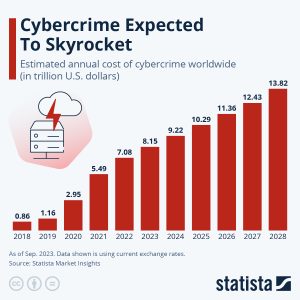
Global cost of cybercrime, Statista (Oct. 10, 2023), https://www.statista.com/chart/28878/global-cost-of-cybercrime/.


The relationship between criminal law and technology has become increasingly critical in today’s digital society. Between 2018 and 2028, the estimated global cost of cybercrime is expected to grow more than sixteen times—from 0.86 to 13.82 trillion U.S. dollars annually. This exponential rise not only underscores the growing scale and sophistication of digital threats but also highlights the urgent need for legal systems to adapt accordingly.

As technologies including artificial intelligence, surveillance systems, social media platforms, and big data analytics become more deeply embedded in daily life, they simultaneously generate new categories of criminal activity, novel investigative methodologies, and complex legal challenges. This research domain explores how legal systems must evolve to address emerging issues such as AI-facilitated crimes, cybercrime, hacking, deepfakes, online harassment, and the incorporation of digital evidence in judicial proceedings. The field also confronts fundamental ethical questions surrounding privacy rights, data collection practices, and algorithmic decision-making within law enforcement contexts. The ultimate objective is to maintain a criminal justice system that remains both equitable and effective while adapting to the accelerating pace of technological innovation.

Within our center specifically, Professor Eldar Haber, Co-Director of HCLT, pursues research focused on the legal regulation of technology, with particular emphasis on its implementation and implications within criminal law contexts.

Latest Researches

Eldar Haber, Criminal Copyright (Cambridge Univ. Press 2018)

Criminal Copyright, published by Cambridge University Press, is a groundbreaking book by Professor Eldar Haber that explores the increasing use of criminal law to enforce copyright in the digital age. The book critically examines how copyright law, originally designed as a civil legal framework, has expanded into the domain of criminal enforcement and often affects digital users and platforms in a disproportionate manner. Professor Haber analyzes the historical development, international patterns, and normative reasons behind this transformation, while raising important questions about its legal validity and broader policy consequences. Drawing on comparative legal analysis and real case studies, the book highlights the tension between protecting intellectual property and safeguarding fundamental rights such as freedom of expression and the right to a fair legal process. Criminal Copyright is considered a key contribution to the evolving field of digital law and is frequently cited in academic literature and policy debates. 

Read more 

Eldar Haber, The Criminal Metaverse, 99 Ind. L.J. 789 (2024)


In The Criminal Metaverse, Professor Eldar Haber examines how the rise of immersive virtual environments introduces new and complex challenges for criminal law. As interactions in the metaverse become increasingly lifelike, so too do the harms that may occur, including virtual assaults, theft of digital property, and manipulation of online identities. Published in the Indiana Law Journal in 2024, the article offers a structured classification of criminal behaviors that can arise within the metaverse and evaluates the extent to which existing legal frameworks can address them. Professor Haber argues that traditional legal doctrines may be inadequate when dealing with offenses that occur in simulated but deeply impactful spaces. The article calls for a rethinking of criminal responsibility, enforcement mechanisms, and legal protections in these environments, urging lawmakers to consider how justice systems must evolve as the boundaries between physical and virtual reality become increasingly blurred.


Read more

Eldar Haber, The Law of the Trojan Horse, 57 U.C. Davis L. Rev. 1667 (2024).


In The Law of the Trojan Horse, Professor Eldar Haber explores the growing use of government-operated spyware tools for criminal investigations and national security purposes. Published in the UC Davis Law Review in 2024, the article focuses on the legal and constitutional implications of state-sponsored malware, often used to infiltrate personal devices and extract data without the user’s knowledge. Professor Haber critically examines how these digital tactics challenge fundamental principles such as privacy, due process, and judicial oversight. He argues that current legal systems often lack the clarity and safeguards needed to regulate this form of surveillance. The article proposes a structured legal framework that includes transparency, accountability, and strict court supervision to ensure that technological capabilities do not outpace the rule of law. Through comparative analysis and real-world examples, the piece raises essential questions about the legitimacy of digital evidence gathering and the preservation of individual rights in modern criminal enforcement.


Read more

Mr. Jörn Kubiack

Mr. Jörn Kubiack is a Ph.D. researcher at the ERC Recoding Justice Lab at Haifa University and advised by Prof. Eldar Haber. His doctoral research addresses the impact of generative AI on criminal justice systems in both the common law and civil law traditions.


Read More »

Dr. Leeor Ofer

Dr. Leeor Ofer is a Postdoctoral Fellow, advised by Prof. Moran Ofir. Leeor is writing a reaserch paper about “Investor Heterogeneity and Securities Fraud.”

Read More »

Mr. Abed Zoabi

Mr. Abed Zoabi is an LLM student, advised by Prof. Daniel Benoliel. Abed is writing an LLM dissertation named “Climate knowledge in public funding – A doctrinal restructuring of administrative grant agreements and intellectual property mechanisms.”

Read More »